
Vietnamese farmers should study market demand to avoid oversupply, losses: PM
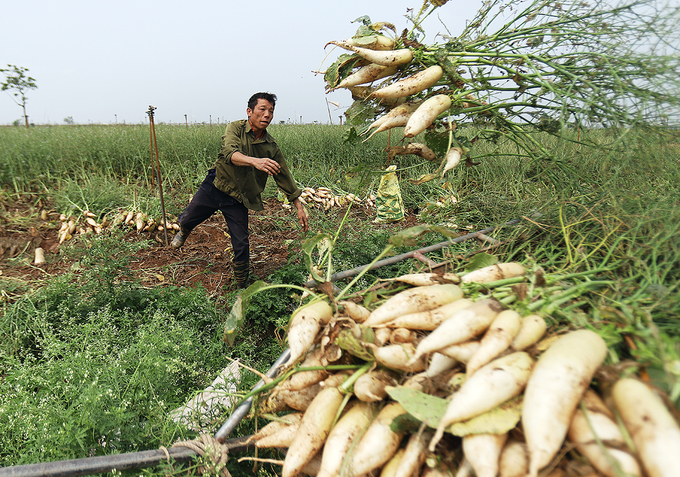
A farmer throws away his haul of radishes. Photo by VnExpress
'Before you sow the seeds, you need to know who you’re selling the crop to and how much you’re selling it for.'
Vietnam’s prime minister has said that farmers should focus more on producing goods that have a market demand while working with investors and entrepreneurs on more efficient production plans.
PM Nguyen Xuan Phuc was speaking with farmers at a conference in the northern province of Hai Duong on Monday, where he listened to cases of oversupply causing them huge losses.
Local farmer Tang Van Truong said recent cases of radishes, kohlrabies and sugarcane being disposed of due to oversupply are a “sad thing” for Vietnamese agriculture. Sharing his sentiment, Dang Thi Diu, a farmer from Quang Ninh Province in northeastern Vietnam, said farmers feel “stuck” because the same problem occurs year after year, while accessing market information remains difficult.
PM Phuc said cases of oversupply are generally localized issues and did not reflect Vietnam’s agriculture sector as a whole. He said the government is calling for more investment in agricultural development to help alleviate the problem.
Phuc also said farmers should try to be more in tune with market demands and produce accordingly, while cooperating with investors, entrepreneurs and communes to better coordinate production plans and prevent future cases of oversupply.
“There needs to be cooperation between farmers, the government, scientists, entrepreneurs, banks and distributors to plan out crop production. Before you sow the seeds, you need to know who you’re selling the crop to and how much you’re selling it for,” said the PM.
Cases of oversupply are a perennial problem in Vietnam. Crops such as watermelons, onions, sugarcane and shallots are fed to livestock or just thrown away instead of being sold due to oversupply that causes massive price drops. Some farmers even say the money they make from selling these products just isn’t worth the effort of selling them in the first place.
According to economists, Vietnam’s oversupply phenomenon is a result of spontaneous production by farmers facilitated by a lack of production plans from the government and virtually no connection or communication between farmers and entities such as investors or entrepreneurs.
Newer news items:
- Vietnamese lychees welcomed in Malaysia - 11/07/2018 09:35
- Red River Delta promotes high-tech agricultural products - 11/07/2018 09:13
- Efforts made to boost Vietnamese fruit exports to China - 11/07/2018 09:08
- Vietnam spends US$ 600 million on importing fruits, vegetables - 11/07/2018 08:58
- US to import Vietnamese mangoes - 11/07/2018 08:40
Older news items:
- High air freight costs hinder Vietnamese fruit exports - 12/06/2018 08:06
- Tropical delicacy: Vietnamese agricultural products rack in big cash at global markets - 12/06/2018 08:01
- China no longer ‘easy’ on Vietnamese agricultural produce - 12/06/2018 07:51
- Towards the sustainable development of banana in Vietnam - 09/11/2017 12:32
- Fruit and Vegetable Research Institute taking part at Techmart 2015 - 09/11/2017 12:28