
New Anthura cultivars of the FAVRI (13/03/2013)
The Fruit and Vegetable Research Institute recommends and encourages farmers in Northern provinces to promote cultivation of 2 new anthura cultivars Alabama and Champion, which were introduced from China . The cultivars have been studied and selected by the FAVRI in the Red River Delta for years.
As the result of the cultivation demonstrations in Hanoi, Hai Duong, Quang Ninh and Son La province, the two cultivars have adapted to develop in the conditions of the North with approximately 90% survival, high branching and flowering ability (3-4 branches/plant; 5-6 flowers/plant). The plants have high disease resistance, produce flowers of dark red and light red after 150 days.
The two cultivars have been potted and brought a high benefit to farmers in Gia Lam (Hanoi), Nhu Quynh, Van Lam (Hung Yen), Hoanh Bo (Quang Ninh), Moc Chau (Son La)…
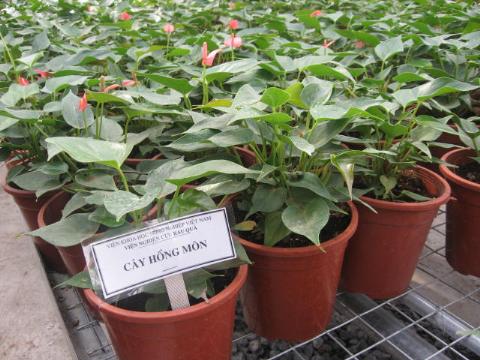
Anthura is an easy plant which requires shade, high humidity. The favor temperature and humidity is 18-20oC and 70-80%, respectively. The leaves become pale if water sufficiency occurs. Otherwise, the plant may get rot and susceptible to diseases. Temperature lower than 15oC causes weak growth, meanwhile too high temperature (higher than 30oC) triggers burnt yellow leaves, even death.
Growing media varies, depending on the conditions of the cultivation region but must be a mixture of porous alluvial soil, manure or compost, fumigated husk and cocopeat. As the result of FAVRI ‘s research, the most favorable growing medium is made up of cocopeat, fumigated husk and compost in the ratio of 1/2 : 1/4 : 1/4.
The best time to transplant is from the third month of the Lunar calendar. When move the plant into pot, remember to cover the root part which is the connection part to the stem with growing media, then keep the plant in the shaded area to prevent wilting. Water for the plant 1-2 times/day but avoid waterlogging which causes plant to susceptible to diseases and death.
In 15 days after transplanting, move the plant to a place with more light and add compound fertilizer to the plant (NPK 16:16:8) once the plant shows yellow leaves and weak development. Other additional products may be sprayed to promote development of the plant, especially quality of the flowers, such as Atonik, B1…
Frequently check for the status of pests (mite, worms, nematodes…) and diseases (rodden of stem, root …). Remove old leaves and weed in the pot for better ventilation ; maintain the favorable humidity and light intensity to avoid development of disease fungi.
Propagation can be done through seeding, from ex-plants or cultured from tissue leaves .
Newer news items:
- Workshop on Plant virus and diagnosis by ELISA (23/04/2013) - 09/11/2017 11:50
- 32nd International Vegetable Training Course (IVTC) - 09/11/2017 11:46
- TFNet - Announcement on International Symposium on super fruits - Myth or truth?" - 09/11/2017 11:45
- Visit of the teachers and students of the Kobe University (20/03/2013) - 09/11/2017 07:00
- Visit of the Mongolian Govermental Delegation (20/03/2013) - 09/11/2017 06:48
Older news items:
- Visit of the Chairwoman of the National Assembly of the Lao People’s Democratic Republic - 09/11/2017 06:35
- Visit of Dr. Andreas Ebert, AVRDC (Dec. 20, 2012) - 09/11/2017 06:30
- Visit of Dr. Pierre Fabre - CIRAD - 09/11/2017 06:16
- Announcement Conference of the website VietGAP-Crop Production - 09/11/2017 06:13
- Visit of Dr Pichit Spirinta - CRARC - 09/11/2017 06:09